Makoko: Eviction is not Development
Rafto laureate 2012 Nnimmo Bassey and his team in HOMEF have examined the eviction of a fishing community in Makoko, Nigeria. Bassey argue that this type of eviction is part of a wider pattern in which “development” is pursued at the expense of marginalized communities and environmental justice.
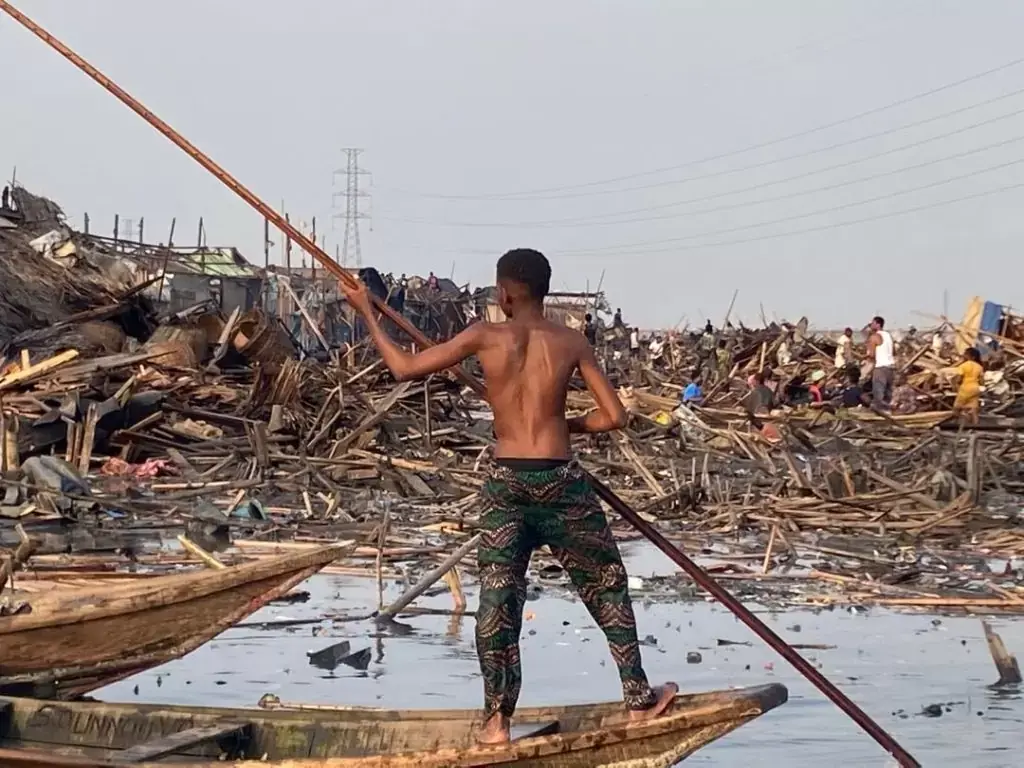
Makoko is an important fishing community located in Yaba Local Government Area of Lagos State, overlooking the Third Mainland Bridge. Demolition squads accompanied by armed security have been bulldozing the community of 300,000 persons from the last week of December 2025 and most viciously from the dawn of the new year. By this condemnable act, the Lagos State Government is displacing the people without due prior informed consultations or plans for resettlement and with no options whatsoever. Makoko people, who are predominantly fishers, have lived peacefully for more than a century, using the proceeds from fishing to support their families and provide shelter, some on stilts and others on land.
HOMEF team and other partners from CAPPA and CEE- HOPE met with affected and displaced members of the Makoko community to show solidarity and offer moral support to the victims of the demolition. On December 23, 2025, the Lagos State Government resumed demolition and eviction operations in the Makoko waterfront community, one of the largest informal fishing settlements.
The demolition of the iconic community extends far beyond the limit of 30, 50, and 100 metres from a power line that passes through the community, rendering thousands homeless and contributing to deteriorating human conditions. About 700 homes, four places of worship, two schools and two clinics had been destroyed by the time of our visit.
The Lagos lagoon waterfront communities, comprising Makoko, Oko-Agbon, and Sogunro, are densely populated, underserved territories that are home to fishing families that have lived there in difficult circumstances for generations. The communities have historically faced periodic threats of eviction and demolition tied to the state government’s urban redevelopment goals and mega-city ambitions. In May 2022, Makoko residents resisted the state government’s planned demolition of their communities through an estate developer. This time, the ears of the government appear largely closed to the pleas of the people.
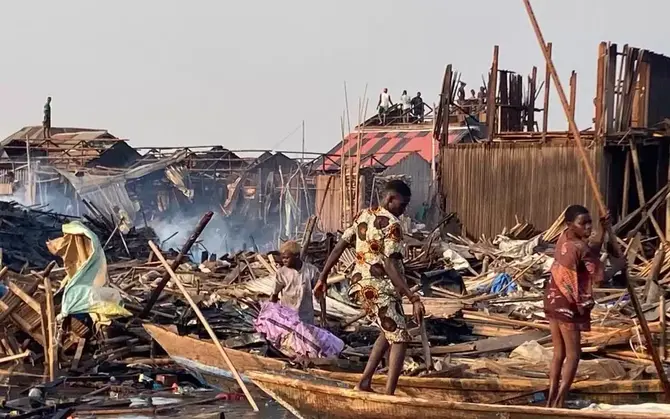
Many households have had their homes and possessions destroyed without prior notice, leaving victims to seek shelter in canoes, which were being used as emergency sleeping platforms on the lagoon.
A resident, Marcel Adingban, who lost his five-day-old baby while narrating the incident, stated that, “My house was not marked for demolition. I went to help my friend whose house was being demolished when I received a call informing me that teargas had been thrown into my compound, and my new baby was coughing and could not breathe. I rushed the baby to the local hospital. Due to a lack of equipment, we were asked to take the baby to the general hospital, but before getting to the hospital, I lost my baby. This is my first child who died from the government’s action”.
Another resident of Makoko, Ayinde Roderick, noted that, “The patients were successfully evacuated from the first clinic. When the ‘doctor’ returned to remove some of his equipment, the place was burnt down. They threw tear gas and fire into the place to burn it down, so everyone ran away. About eight houses were burnt.”
The secretary of Fishnet Alliance in Makoko, during a detailed narration, noted that, “The youths and community members were informed that security operatives and contractors had received an order to prevent access to the waterside and to take over the entire waterfront area. When community representatives went to engage the officials, a commanding officer confirmed that the instruction they received was to demolish the entire waterside. The officer further stated that they were acting strictly on orders and would only stop if a counter-order was received. This directly contradicted the earlier agreement with the government to limit demolitions to 100 metres from the power lines. Community members challenged this inconsistency and insisted that the agreed-upon terms were clear and should be adhered to. The officials then stated that if the work extended beyond 100 metres, the community could protest, and that their superior would later come to verify and measure whether the agreed distance had been exceeded. Saw this response as a pretest to fool us because a metre is universally the same and does not change irrespective of who measures it.”
He further stated that, “In response to the situation, the community contacted six to seven television stations, and journalists visited the area to document and report on the demolition activities. The witness stated that media coverage was necessary because the situation represented a clear case of intrusion and intimidation, with children having died as a result of the stress, displacement, and conditions caused by the ongoing actions. One such case involved a woman who died, leaving behind children who were present during the events.”
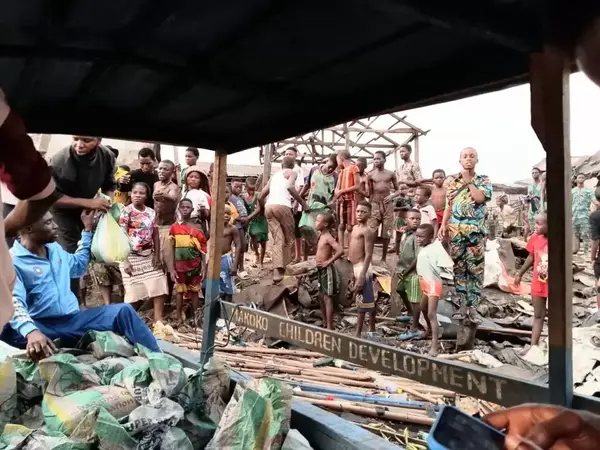
Nnimmo Bassey, while visiting affected areas of Makoko to commiserate with displaced residents, stated that “Makoko is a historic community that has existed for centuries and plays a vital role in Lagos’ social and economic life. Makoko did not just happen yesterday. This is a community that has been here for generations. Destroying it is a shame on Lagos State and a shame on Nigeria. The government is obviously acting in connivance with private interests to dispossess residents without due process or resettlement plans.”
Bassey further recalled the 1990 demolition of Maroko under a former military administration, which displaced over 300,000 people, warning that the current exercise risks repeating a painful history.
“Demolishing communities is never a solution. Government is meant to protect and serve the people, not render them homeless. This assault on the urban poor is comparable to what Nigerians suffer from bandits in other parts of the country. Forced evictions and land-grabbing are repugnant and must be halted.”
The government has ordered all demolition victims to vacate the area completely and stop sleeping in boats on the lagoon. Children and vulnerable groups are disproportionately affected. Parents shared that children have lost school materials and uniforms and are unable to return to classes, while adults are struggling to preserve livelihoods tied to fishing and trade. Without shelter, food supplies, clean water, waste disposal, or healthcare facilities, insecurity has intensified. Several families expressed concerns about their safety, citing exposure to the elements and the risk of sleeping over open water.
The demolition of homes in Makoko is not merely an urban planning exercise but a deepening humanitarian crisis with long-term socioeconomic repercussions. Residents face displacement, loss of income, disrupted education, and acute insecurity. Unless immediate corrective action is taken – grounded in human rights, law, and dignified engagement – the aftermath will continue to affect the most vulnerable families in Lagos.
Contact
Therese Jebsen
Senior Advisor| Means of contact | Contact details |
|---|---|
| Phone: | +4741511390 |
| E-mail: | therese.jebsen@rafto.no |